Elbow pain can make everyday tasks surprisingly difficult. Turning a doorknob, lifting groceries, typing at a desk, carrying a child, or reaching for a coffee mug may suddenly cause sharp discomfort or a deep, nagging ache. In Houston, TX, many adults experience elbow pain from repetitive work, sports, home projects, exercise, or age-related joint changes. The challenge is that several different conditions can feel similar at first.
Three common explanations are tennis elbow, arthritis, and nerve-related pain. While each can cause elbow discomfort, they do not always affect the same part of the joint, create the same kind of pain, or respond to the same treatment approach. Understanding the differences can help you know when elbow pain may improve with rest and activity changes, and when it deserves prompt medical attention.
This article explains common elbow pain causes in Houston, TX, how tennis elbow vs arthritis in Houston may feel different, when elbow nerve pain in Houston, TX may be the issue, and what to know about non-surgical elbow pain treatment in Houston. This information is for general education only and is not a diagnosis. If your symptoms are severe, persistent, or affecting daily function, consult a qualified clinician for a personal evaluation.
Why elbow pain happens
The elbow is a complex joint where the upper arm bone meets the two forearm bones. It also includes tendons, ligaments, cartilage, muscles, bursae, and nearby nerves. Because the elbow helps with lifting, gripping, pushing, pulling, and rotation of the forearm, it is exposed to both repetitive strain and direct stress.
Elbow pain may develop from:
- Overuse injuries from repeated gripping, lifting, twisting, or wrist extension
- Degenerative joint changes such as osteoarthritis
- Inflammatory conditions that affect the joint lining
- Nerve irritation or compression near the elbow, neck, or forearm
- Acute injuries like sprains, fractures, or tendon tears
- Bursitis, which can cause swelling over the tip of the elbow
Because these issues can overlap, location and pattern matter. Pain on the outside of the elbow often suggests a tendon problem, while stiffness deep in the joint may point more toward arthritis. Tingling or numbness raises concern for nerve involvement.
Tennis elbow: one of the most common causes of outer elbow pain
Tennis elbow, also called lateral epicondylitis, is a common overuse condition involving the tendons that attach to the outer part of the elbow. Despite the name, many people with tennis elbow do not play tennis. It often affects people who use their hands and forearms repetitively for work, fitness, or home tasks.
Typical symptoms of tennis elbow
Tennis elbow usually causes pain on the outside of the elbow. The discomfort may start gradually and worsen with activity. Common signs include:
- Pain or burning on the outer elbow
- Tenderness when pressing the bony outer part of the elbow
- Pain with gripping, lifting, shaking hands, or turning tools
- Discomfort when extending the wrist or lifting with the palm down
- Weak grip due to pain
A person might notice symptoms while using a mouse all day, lifting workout weights, carrying heavy bags, painting, using a screwdriver, or doing repetitive assembly work. In many cases, the pain is activity-related rather than constant at rest.
Who gets tennis elbow?
Tennis elbow can affect athletes, but it is also common in office workers, mechanics, warehouse staff, hair stylists, cooks, caregivers, and anyone performing repeated arm and wrist motions. Poor movement mechanics, sudden increases in workload, and inadequate recovery can all contribute.
Arthritis: when elbow pain is more about the joint itself
Arthritis in the elbow is less common than arthritis in the knees or hands, but it can still occur. Osteoarthritis is usually related to wear and tear over time, previous injury, or heavy repetitive use. Other inflammatory forms of arthritis may also affect the elbow.
Typical symptoms of elbow arthritis
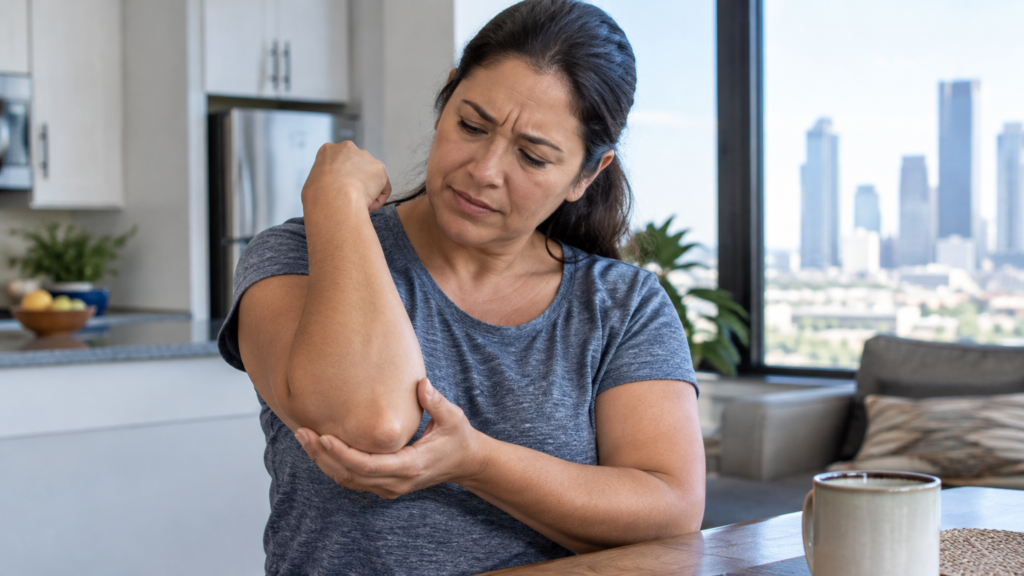
Arthritis often feels different from tendon-related pain. Instead of pain mainly during gripping or wrist motion, arthritis may cause more joint stiffness and deep aching. Symptoms can include:
- Deep pain within the elbow joint
- Stiffness, especially after rest
- Pain during bending or straightening the elbow
- Swelling around the joint
- Grinding, clicking, or catching sensations
- Reduced range of motion
Some people feel worse in the morning or after periods of inactivity. Others notice that the elbow no longer fully straightens or bends. If there are loose bodies or advanced joint changes, the elbow may occasionally lock or catch.
When arthritis is more likely
Arthritis may be more likely if you have a history of elbow injury, long-term heavy use, advancing age, or known inflammatory joint disease. Unlike tennis elbow, the pain is often more centered in the joint and may be accompanied by stiffness even when you are not using the arm heavily.
Nerve-related elbow pain: when tingling, numbness, or radiating symptoms appear
Not all elbow pain starts in the tendons or joint. Sometimes the problem involves a nerve. One common example is irritation of the ulnar nerve, which runs near the inner side of the elbow through the cubital tunnel. This is the nerve people often hit when they strike their “funny bone.”
Other nerve issues can involve the radial nerve or even a problem in the neck that sends pain down the arm. That is why elbow nerve pain in Houston, TX may feel different from tendon or arthritis pain.
Typical symptoms of nerve-related elbow pain
Nerve symptoms may include:
- Tingling or numbness in the ring and little fingers
- Electric, shooting, burning, or radiating pain
- Pain on the inner side of the elbow, especially with prolonged bending
- Hand weakness or clumsiness
- Symptoms that worsen at night or while holding a phone
- Discomfort that travels down the forearm rather than staying in one spot
For example, someone with cubital tunnel syndrome may notice numbness after sleeping with the elbow bent, driving for long periods, or leaning on the elbow at a desk. In more persistent cases, gripping and fine motor tasks may become harder.
Tennis elbow vs arthritis vs nerve pain: key differences
Because symptoms can overlap, a side-by-side comparison can help clarify the pattern.
| Condition | Common pain location | Typical symptoms | Often worsened by |
|---|---|---|---|
| Tennis elbow | Outside of the elbow | Tenderness, pain with gripping or lifting, weak grip due to pain | Repetitive wrist use, lifting, tool use, racquet sports |
| Arthritis | Deep in the joint or around the elbow | Stiffness, aching, reduced motion, swelling, grinding or catching | Joint motion after rest, chronic overuse, advanced wear |
| Nerve problem | Inner elbow or radiating into forearm/hand | Tingling, numbness, burning, shooting pain, hand weakness | Leaning on elbow, prolonged bending, some neck or arm positions |
This comparison is helpful, but it is not enough to diagnose every case. A tendon problem can coexist with nerve irritation. Arthritis can also irritate nearby nerves. That is why a proper exam matters when symptoms do not improve.
Other possible elbow pain causes in Houston, TX
Although tennis elbow, arthritis, and nerve irritation are common, they are not the only explanations. Other causes of elbow pain include:
- Golfer’s elbow, which affects the inner side of the elbow
- Olecranon bursitis, causing swelling at the tip of the elbow
- Ligament sprains from sports or sudden force
- Tendon tears involving the biceps or triceps
- Fractures or dislocations after trauma
- Referred pain from the neck, shoulder, or upper back
If elbow pain started after a fall, blow, heavy lift, or sudden pop, an acute injury should be considered. Mechanical symptoms like obvious instability, inability to move the joint, or rapid swelling deserve prompt medical evaluation.
When to seek urgent medical attention
Some elbow problems can wait for a routine appointment, but others should be assessed right away. Seek urgent medical care if you have:
- Severe pain after an injury or fall
- Visible deformity
- Inability to move the elbow
- Rapid swelling or significant bruising
- Numbness that is sudden or worsening
- Marked weakness in the hand or arm
- Signs of infection such as redness, warmth, fever, or draining fluid
- Elbow pain along with chest pain, shortness of breath, or other emergency symptoms
These warning signs may suggest a fracture, dislocation, serious nerve problem, infection, or another condition that should not be self-treated.
How elbow pain is evaluated
A clinician typically starts by asking when the pain began, where it hurts, what activities make it worse, and whether there is numbness, weakness, swelling, or stiffness. The physical exam may include checking range of motion, tenderness, grip strength, sensation, reflexes, and specific movements that reproduce symptoms.
Depending on the findings, evaluation may include:
- X-rays to look for arthritis, fractures, alignment problems, or calcification
- Ultrasound or MRI in selected cases to assess soft tissues such as tendons and ligaments
- Nerve testing if a nerve compression problem is suspected
- Lab work when inflammatory arthritis or infection is a concern
This process helps distinguish tennis elbow vs arthritis in Houston and identify whether nerve involvement is contributing to symptoms.
Non-surgical elbow pain treatment in Houston
Many cases of elbow pain improve without surgery, especially when addressed early and matched to the correct cause. Non-surgical elbow pain treatment in Houston may vary based on whether the issue is tendon-related, arthritic, or nerve-related, but common conservative strategies include the following.
Activity modification
Reducing or adjusting the movements that trigger pain is often one of the most effective first steps. That may mean changing lifting technique, taking more breaks, altering workstation setup, reducing repetitive gripping, or avoiding leaning on the elbow.
Ice or heat
Ice may help calm irritation after activity, especially in overuse conditions. Heat may feel better for stiffness, particularly when arthritis is involved. Some people benefit from both at different times.
Bracing or support
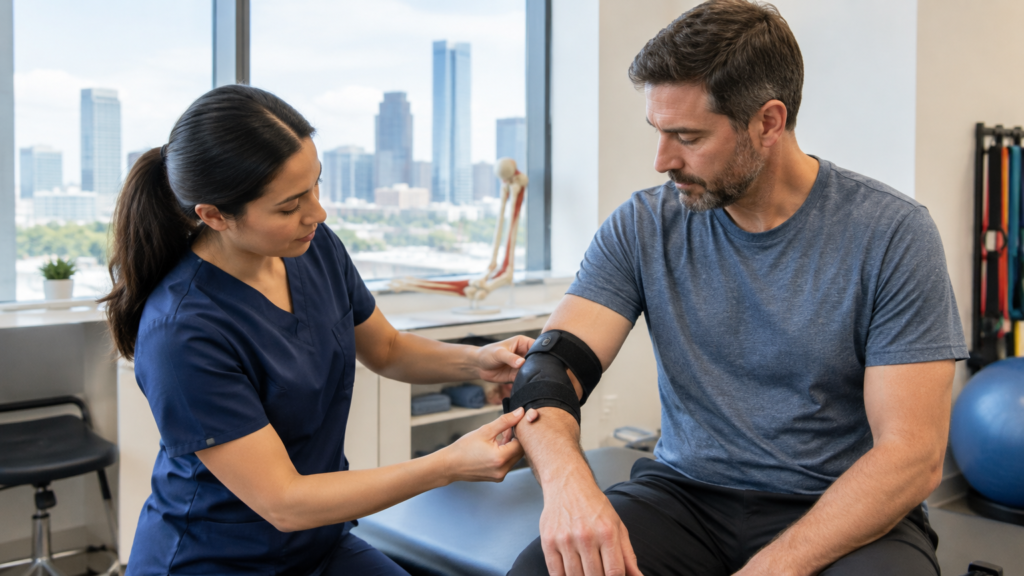
A counterforce strap may sometimes help with tennis elbow. A wrist brace or nighttime elbow positioning support may be useful in selected cases. For nerve-related symptoms, avoiding prolonged elbow flexion and direct pressure can be important.
Physical or occupational therapy
Therapy can be very helpful for many elbow problems. Treatment may focus on:
- Stretching and strengthening of the forearm and upper extremity
- Eccentric exercises for tendon issues
- Manual therapy and mobility work
- Posture and ergonomic correction
- Nerve gliding exercises when appropriate
- Grip and movement retraining
Therapy is often most effective when the program matches the diagnosis rather than taking a one-size-fits-all approach.
Medications
Over-the-counter pain relievers or anti-inflammatory medications may help some people, depending on their overall health and any medication restrictions. These are not appropriate for everyone, so it is wise to ask a clinician or pharmacist if you have questions, especially if you have kidney disease, ulcers, bleeding risk, or take blood thinners.
Injections or other office-based care
In selected cases, a clinician may discuss injections or other non-surgical interventions. The right option depends on the diagnosis, symptom severity, and response to earlier treatment. Because benefits and risks differ by treatment type, decisions should be individualized.
Practical examples: how symptoms often show up in daily life
Sometimes the pattern becomes clearer in real-world situations.
Example 1: Outer elbow pain after repetitive work
A person who spends hours using hand tools or lifting boxes may feel tenderness on the outer elbow and pain when gripping a coffee mug or shaking hands. That pattern is more consistent with tennis elbow than arthritis.
Example 2: Deep stiffness and loss of motion
Someone with prior elbow injury may notice that the elbow feels stiff in the morning, aches deep in the joint, and no longer fully straightens. Clicking or catching can suggest arthritis or another joint-related problem.
Example 3: Numb fingers at night
A desk worker who leans on the elbow and sleeps with the arm bent may wake up with tingling in the ring and little fingers. That pattern raises concern for ulnar nerve irritation rather than a simple tendon problem.
Important considerations before self-diagnosing
It is tempting to label any elbow pain as “tennis elbow,” especially if the discomfort is on the outside of the joint. But self-diagnosis can be misleading. Pain location alone does not always tell the full story. A person may have more than one issue at once, or pain may actually be referred from the neck or shoulder.
It is also important not to push through worsening pain for too long. Delaying evaluation can make recovery harder if the underlying problem involves significant nerve compression, a tendon tear, major loss of motion, or progressive joint damage.
General education can help you recognize patterns, but a clinician can evaluate your symptoms in context, examine the arm, and determine which treatment plan best fits your situation.
Protecting elbow health over time
Not every elbow problem can be prevented, but several habits may reduce strain:
- Warm up before sports, workouts, or repetitive tasks
- Increase activity gradually rather than all at once
- Improve ergonomics for desk work and tool use
- Use proper lifting and gripping mechanics
- Strengthen the forearm, shoulder, and upper back
- Take breaks during repetitive work
- Avoid prolonged pressure on the elbows
These steps are especially helpful for people whose jobs or hobbies place repeated stress on the forearm and elbow.
Conclusion
Elbow pain is common, but the cause is not always obvious. In Houston, TX, some of the most frequent explanations include overuse tendon problems such as tennis elbow, joint-related issues such as arthritis, and nerve irritation that can cause tingling, numbness, or radiating pain. The pattern of symptoms often provides clues: outer elbow pain with gripping suggests tennis elbow, deep stiffness and reduced motion can point toward arthritis, and numbness or burning may indicate a nerve problem.
Because the right treatment depends on the right diagnosis, persistent or worsening symptoms should not be ignored. Many people improve with non-surgical elbow pain treatment in Houston, including activity changes, therapy, bracing, and other conservative care. Still, severe pain, sudden weakness, major swelling, or symptoms after trauma deserve prompt evaluation. If you are unsure what is causing your elbow pain, a qualified clinician can help determine whether it is tennis elbow, arthritis, a nerve issue, or another condition entirely.