Tendon pain can be stubborn. Whether it starts as soreness at the outside of the elbow, aching in the shoulder, or tight pain above the heel, tendon injuries often interfere with work, exercise, sleep, and simple daily movement. Many people try rest, ice, braces, physical therapy, and anti-inflammatory medication, only to find that symptoms keep returning or never fully settle down.
That frustration is one reason platelet-rich plasma, often called PRP, has gained attention. People looking into PRP for tendon injuries in Houston usually want to know one thing: can it actually help? The answer depends on the type of tendon problem, how long it has been present, the severity of tissue damage, and whether PRP is being used as part of a broader treatment plan.
PRP is not a magic fix, and it is not right for every tendon condition. However, for certain chronic overuse injuries, it may be a useful option when conservative care has not provided enough relief. This article explains what PRP is, how tendon injuries develop, and what to know about PRP for tennis elbow, PRP for rotator cuff pain, and PRP for Achilles tendonitis.
Understanding tendon injuries
Tendons are strong bands of connective tissue that attach muscle to bone. They help transfer force so the body can lift, reach, grip, push off, throw, and stabilize joints. Because tendons are constantly under mechanical stress, they can become irritated or damaged over time.
Some tendon problems happen suddenly after a strain or partial tear, but many develop gradually. Repetitive motion, poor movement mechanics, aging tissue, sports participation, job demands, and inadequate recovery can all play a role. Common symptoms include:
- Pain with activity or after activity
- Morning stiffness
- Tenderness at a specific attachment point
- Weakness or reduced endurance
- Pain when gripping, lifting, reaching, or walking
- Symptoms that improve temporarily but return with use
People often use the term tendonitis for any tendon pain, but chronic cases are not always driven mainly by active inflammation. In many long-standing injuries, the tendon shows degenerative changes, altered collagen structure, and reduced tissue quality. That distinction matters because treatments aimed only at reducing inflammation may not fully address the underlying problem.
What PRP is and how it works
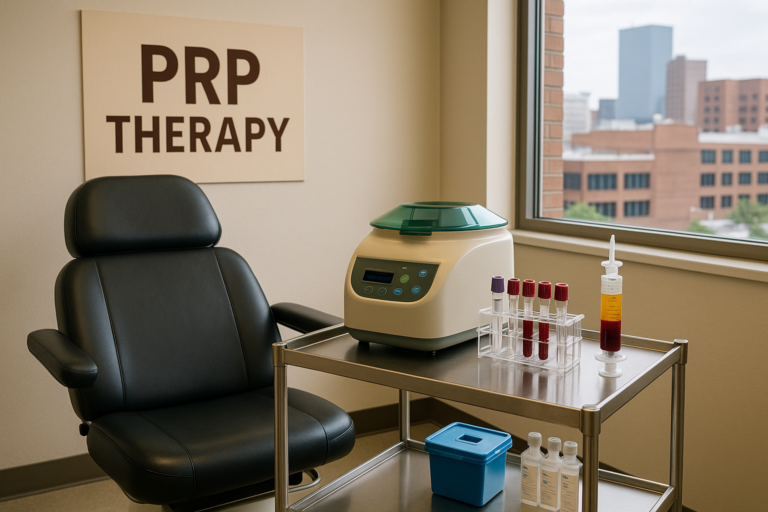
PRP stands for platelet-rich plasma. It is created from a sample of a patient’s own blood. The blood is processed so that the platelet concentration in the plasma portion is higher than usual. Platelets are best known for helping blood clot, but they also contain growth factors and signaling proteins involved in tissue repair.
In a PRP procedure, the prepared platelet-rich plasma is injected into or around the injured tendon area. The goal is to support the body’s healing response in tissue that may be slow to recover on its own.
From a general medical perspective, PRP is often considered when a tendon injury has persisted despite more standard conservative treatment. It is commonly discussed for chronic overuse conditions rather than fresh, complete ruptures that may require different management.
PRP is not the same as cortisone. A corticosteroid injection is typically used to calm inflammation and reduce pain, but it does not aim to stimulate tendon healing in the same way. In some tendon conditions, repeated steroid injections may even raise concern about weakening tissue. PRP is used with a different intent: to encourage a more constructive healing environment.
Why PRP is being considered for chronic tendon pain
Tendons generally have a limited blood supply compared with some other tissues, which is one reason they may heal slowly. When a tendon is repeatedly overloaded, the body may struggle to keep up with repair. That can leave people stuck in a cycle of pain, reduced activity, deconditioning, and recurrent flare-ups.
PRP is appealing because it uses a patient’s own biological material and is designed to target the injured tissue directly. For the right patient, it may offer a middle ground between basic conservative care and more invasive options. It is often paired with a structured rehab plan rather than used as a stand-alone treatment.
That said, PRP results are not uniform. Different preparation methods, injection techniques, injury types, and rehab protocols can influence outcomes. The best way to think about PRP is as a potential tool, not a guaranteed cure.
PRP for tennis elbow
PRP for tennis elbow is one of the most commonly discussed uses of this treatment. Tennis elbow, also called lateral epicondylitis or more accurately lateral elbow tendinopathy, affects the tendons that attach forearm muscles to the outside of the elbow. Despite the name, many people who get tennis elbow do not play tennis at all.
What tennis elbow feels like
Tennis elbow often causes pain on the outer part of the elbow, especially with gripping, lifting, turning a doorknob, shaking hands, typing for long periods, or using tools. It may start as mild soreness and gradually become sharp or limiting. People who work with repetitive hand and wrist motions, such as mechanics, office workers, hair stylists, tradespeople, and racquet sport players, may be especially prone to it.
When PRP may be considered
Many cases improve with activity modification, bracing, exercise-based therapy, and time. But when symptoms have lasted for months and continue to interfere with function, PRP may enter the discussion. Chronic tennis elbow is often more degenerative than inflammatory, which is part of the reason PRP has been studied for it.
A practical example is someone who has had elbow pain for six months, has already tried rest and physical therapy, and still cannot comfortably grip weights, carry groceries, or complete job tasks. In that situation, PRP may be considered as part of a more targeted treatment plan.
Potential benefits and limitations
The main potential benefit of PRP for tennis elbow is that it may help stimulate healing in damaged tendon tissue, rather than only masking pain. Some patients pursue it because they want to avoid repeated steroid injections or because earlier treatments brought only temporary relief.
However, improvement can take time. It is not unusual for recovery to unfold over weeks to months rather than days. Some soreness after the injection is also common. Results may be better in appropriately selected patients with chronic tendinopathy than in those whose pain is coming from a different source, such as nerve irritation, neck-related symptoms, or joint arthritis.
PRP for rotator cuff pain
PRP for rotator cuff pain is more nuanced because shoulder pain can come from several structures and not every case involves the same kind of tendon damage. The rotator cuff is a group of muscles and tendons that help stabilize the shoulder and control lifting and rotation.
Common causes of rotator cuff-related pain
Rotator cuff pain may develop from overuse, repetitive overhead motion, age-related tissue changes, poor shoulder mechanics, partial tendon tearing, or a combination of factors. It can cause aching on the outside of the shoulder, pain reaching overhead, discomfort sleeping on the affected side, weakness lifting the arm, and pain with throwing or repetitive work tasks.
Sometimes the problem is mainly tendinopathy. Other times there may be bursitis, impingement, a partial tear, or more significant structural damage. Because of that, evaluation matters before deciding whether PRP is a reasonable option.
Where PRP may fit in shoulder care
PRP may be considered in certain cases of chronic rotator cuff tendinopathy or partial tendon injury, especially when a patient has not improved enough with rest, therapy, and movement correction. The idea is similar to other tendon applications: support the healing response in tissue that has not recovered fully.
For example, a person may have shoulder pain that has lingered for months despite physical therapy and activity changes. They may be able to function but continue to have pain with reaching into cabinets, lifting luggage, or doing gym exercises. If imaging and exam findings suggest a tendon issue that could respond to biologic treatment, PRP may be discussed.
Important considerations for rotator cuff pain
Not every shoulder problem is a good match for PRP. If someone has a large or complete tendon tear, significant loss of strength, major joint degeneration, or a condition requiring surgical evaluation, PRP may not be the most appropriate next step. In some cases, it may play a supportive role, but it should not delay necessary diagnosis or treatment.
The shoulder is also a complex joint, so precise diagnosis is especially important. Pain that feels like a rotator cuff problem could instead come from the neck, the biceps tendon, the joint capsule, or arthritis. A careful assessment helps determine whether PRP is being directed at the right target.
PRP for Achilles tendonitis
PRP for Achilles tendonitis is another common area of interest, particularly among runners, active adults, and people whose jobs involve long periods of standing or walking. The Achilles tendon connects the calf muscles to the heel bone and handles tremendous force with each step, jump, and push-off.
How Achilles tendon problems develop
Achilles pain often comes on gradually. People may notice stiffness first thing in the morning, tenderness a few centimeters above the heel, pain during running, or soreness after climbing stairs. In insertional Achilles problems, pain may be closer to where the tendon attaches at the heel bone. In other cases, the tendon is painful higher up in the mid-portion.
Contributing factors can include a sudden increase in training, tight calf muscles, poor footwear, reduced ankle mobility, age-related tissue changes, and repeated overload without enough recovery.
When PRP may be useful
Conservative treatment for Achilles tendon problems often includes load management, eccentric or progressive strengthening exercises, calf flexibility work, and footwear or activity adjustments. If the condition becomes chronic and symptoms persist despite a solid rehab effort, PRP may be considered.
A practical example is a runner who has reduced mileage, done a strengthening program, and still cannot return to training without pain. Another example is a person who works on their feet all day and continues to experience tendon pain that limits walking endurance even after trying standard treatment. In select cases, PRP may be part of the next phase of care.
Cautions with Achilles tendon pain
Achilles tendon disorders range from mild tendinopathy to partial tearing and, in severe cases, complete rupture. Because the Achilles is so important for walking and push-off strength, evaluation is important when symptoms are significant. Sudden sharp pain, a popping sensation, marked weakness, or difficulty pushing off the foot can suggest a more serious injury that needs prompt medical assessment.
For chronic tendinopathy, PRP may be one option, but it usually works best when paired with a guided strengthening and return-to-activity plan. Tendons generally respond to progressive loading, so rehab remains an important part of recovery.
What to expect from a PRP treatment process
Although protocols vary, the general PRP process is fairly straightforward. A blood sample is drawn, prepared to concentrate the platelet-rich portion, and then injected into the targeted area. Many clinicians use image guidance, such as ultrasound, to improve precision, especially around tendons and joints.
After the injection, patients may be advised to modify activity for a short period and then follow a structured recovery plan. That may include:
- Temporary reduction in strenuous use of the injured area
- A gradual return to movement
- Physical therapy or home exercises
- Progressive strengthening
- Changes in training load, posture, body mechanics, or equipment
Recovery is usually not immediate. PRP aims to support tissue healing, which takes time. People considering it should understand that improvement may be gradual and often depends on what they do after the injection as well as the injection itself.
Benefits people hope to gain from PRP
Patients exploring PRP for tendon injuries often want more than temporary symptom suppression. Common goals include:
- Reducing persistent pain that has not improved enough with conservative care
- Improving function for work, sports, and daily activity
- Supporting healing in chronic tendon tissue
- Avoiding or delaying more invasive treatment in appropriate cases
- Using a treatment derived from the patient’s own blood rather than a synthetic drug
For many people, the biggest appeal is the possibility of addressing the tendon problem more directly. This is especially relevant when symptoms keep returning after rest alone or when pain relief from other treatments has been short-lived.
Important limitations and realistic expectations
PRP should be approached with realistic expectations. While it may help some tendon conditions, it is not universally effective and is not appropriate for every diagnosis. The quality of evidence varies depending on the tendon involved, the chronicity of the injury, and the way PRP is prepared and delivered.
Key points to keep in mind include:
- PRP is not an instant fix
- Response can vary from person to person
- Accurate diagnosis is essential
- Rehabilitation remains important
- Some injuries are too advanced or structurally severe for PRP alone
In addition, pain in the elbow, shoulder, or Achilles region is not always caused by tendon degeneration. A skilled evaluation helps rule out other issues and improves the chances of selecting the right treatment.
Who may be a reasonable candidate for PRP
Although individual decisions must be made with a qualified clinician, people who may be reasonable candidates for PRP often share several characteristics:
- They have a tendon injury that has persisted for weeks or months
- They have tried standard conservative treatment without enough improvement
- Their symptoms match a tendinopathy or partial tendon injury pattern
- They want a non-surgical option when appropriate
- They are willing to follow post-procedure rehab guidance
On the other hand, PRP may be less suitable if the diagnosis is unclear, if the tendon is fully ruptured, if symptoms point to a different source of pain, or if the patient is unable to commit to the rehab process that follows.
Why diagnosis matters before any injection
It is tempting to focus only on the painful area, but tendon pain is often influenced by the way the body moves as a whole. A person with tennis elbow may also have poor wrist mechanics or shoulder weakness. Someone with rotator cuff pain may have scapular control issues or neck involvement. A person with Achilles tendonitis may have calf weakness, ankle stiffness, or a training error.
That is why a thorough history, physical exam, and sometimes imaging can be so helpful. PRP tends to make the most sense when the source of pain is clearly identified and the treatment is part of a broader strategy to reduce overload and improve tissue capacity.
PRP compared with other common tendon treatments
PRP is only one option within tendon care. Depending on the condition, treatment may also involve:
- Relative rest and activity modification
- Physical therapy
- Bracing or supportive devices
- Progressive strengthening
- Manual therapy
- Short-term pain management strategies
- Ultrasound-guided injections
- Surgical consultation when structurally necessary
For some people, exercise-based rehab alone is enough. For others, PRP may be considered after a plateau. The best approach usually depends on the type of tendon involved, how long symptoms have lasted, and how much the problem is affecting quality of life.
Practical examples of when people start considering PRP
Office or manual work strain
A person with chronic elbow pain may struggle with gripping a mouse, lifting files, using tools, or carrying equipment. If symptoms have lasted long enough to affect job performance despite conservative care, PRP may be part of the conversation.
Active adults who cannot return to exercise
Someone with rotator cuff pain may stop swimming, golf, tennis, or weight training because overhead motion keeps aggravating the shoulder. If months of rest and therapy have not resolved the issue, PRP may be explored after proper evaluation.
Runners and walkers limited by Achilles pain
A person with Achilles tendonitis may no longer be able to train, take long walks, or handle a full day on their feet. When load management and strengthening have not been enough, PRP may be considered as an additional option.
Recovery habits that still matter after PRP
Even if PRP is appropriate, the injection itself is only part of the picture. Tendon healing generally responds best when the surrounding habits support recovery. Helpful measures often include:
- Following the recommended rehab timeline instead of rushing back too soon
- Gradually rebuilding strength and tendon tolerance
- Correcting repetitive movement patterns that may have contributed to the problem
- Improving warm-up and recovery habits
- Using footwear, ergonomics, or sports technique changes when relevant
This is especially important because many tendon injuries are caused or maintained by repeated overload. If the same stress pattern continues unchanged, the tendon may remain vulnerable.
What Houston-area patients often want to know
People searching for PRP for tendon injuries in Houston are often balancing convenience, recovery time, and the desire to avoid surgery if possible. Many are looking for an option that fits into a busy schedule while still addressing the injury in a meaningful way. Others are simply trying to understand whether PRP is worth considering after months of stalled progress.
The most helpful starting point is not hype but clarity: identify the tendon involved, confirm the diagnosis, review what treatments have already been tried, and decide whether PRP logically fits the stage and type of injury. That process helps set realistic expectations and supports better decision-making.
Conclusion
PRP has become an important topic in the treatment of chronic tendon pain, and in the right setting, it may offer meaningful help. For some patients, PRP for tennis elbow may be considered when elbow pain keeps returning despite rest and therapy. For others, PRP for rotator cuff pain may be part of a plan for chronic shoulder tendinopathy or partial tendon injury after a careful evaluation. And for active adults dealing with persistent heel and calf-region pain, PRP for Achilles tendonitis may be an option when progressive rehab alone has not been enough.
The key is thoughtful use. PRP is not a universal answer, and it works best when the diagnosis is accurate, the injury is appropriate for this approach, and the treatment is paired with a solid rehabilitation strategy. For anyone researching PRP for tendon injuries in Houston, the most productive next step is understanding the true cause of the pain and choosing a treatment plan that matches the tendon, the symptoms, and the demands of daily life.